
The right systems first
See urgent reviews, unknown versions and overdue actions, then open the evidence behind them.
THE CIRCL SERVICE FOR COMPANY TEAMS
Your infrastructure inventory, vulnerability reviews and responsible contacts in one workspace operated by CIRCL. See what needs attention, assign the next step and keep your team reachable.
What the vulnerabilities have to say
Development & pilot stageStart with a contact and one domain. Add inventory at your own pace.

Product view · synthetic data
Operated by CIRCL
CIRCL is Luxembourg’s CERT for the private sector and municipalities. The Law of 5 May 2026 implementing NIS2 designates CIRCL as a CSIRT; Article 9 names CIRCL as the coordinator for coordinated vulnerability disclosure. We scan for vulnerabilities and support voluntary information sharing so organizations can act earlier.
A practical benefit for your team
When an alert arrives, find the systems and versions you have recorded, the evidence to check and the right person to act. Start small and add the information that is useful to your company.
See urgent reviews, unknown versions and overdue actions, then open the evidence behind them.
Keep accountable owners and emergency contacts together. Periodic confirmation helps keep those details useful.
Keep NetBox or review a CSV import. A contact and one domain or network are enough to get started.
Real problems. A little personality.
Playful fictional quotes. Real CVEs. Each example shows why recorded versions and reachable contacts matter.
NGINX2Root
I was hoping your inventory stopped at “web server”. Then you wrote down the NGINX version. Awkward.
NGINX2Root groups five NGINX flaws disclosed in November 2026, including CVE-2026-123007. Relevant features and configuration matter.
Find recorded NGINX installations and package versions, check the applicable vendor or distribution advisory, and reach the team that can update them.
Source advisory · Additional source · CIRCL analysisJava / Java4Shell
“Somewhere there’s probably Java” used to be my favourite inventory entry. Bearings is ruining the mystery.
Oracle addressed CVE-2026-114938 in its 17 November 2026 update. CISA urged organizations to identify affected Java runtimes, including bundled ones.
Record the runtime vendor and exact build, connect it to the application and owner, then check the current vendor guidance. “Java installed” is not enough.
Source advisory · Additional source · CIRCL analysisCisco Secure FMC
An inventory, a named owner and follow-up? Honestly, terrible working conditions.
Authentication bypass in Cisco Secure FMC. Active exploitation reported in 2026; CISA listed it on 9 September.
Find recorded management platforms and versions, review the advisory and give the right team a concrete next step.
Source advisory · Additional sourceReact Server Components
Five stars for finding the right servers. Zero stars for my career prospects.
Unauthenticated remote code execution in React Server Components, disclosed on 3 December 2025.
Record component versions, not just ‘React’. Narrow the review to the installations and owners that need checking.
Source advisoryFortiCloud SSO
I was rather hoping nobody remembered which firmware was running. Bearings had other plans.
FortiCloud SSO authentication bypass. CERT-FR relayed active exploitation on 28 January 2026.
Locate recorded appliances and firmware, verify the relevant SSO configuration and reach the responsible contact.
Source advisorySources checked 19 November 2026. Historical examples, not a live threat feed. Check whether an installation is affected and how to address it using current vendor guidance.
Two perspectives. A connected workflow.
For company teams
A software issue should lead to the systems that may be affected, the supporting evidence and a clear next action. Bearings groups related reviews, keeps priorities visible and records who is responsible.

For CIRCL analysts
Explore permitted inventory across participating companies. Research a reported software version before a CVE exists, review prevalence and contact the appropriate responsible team.
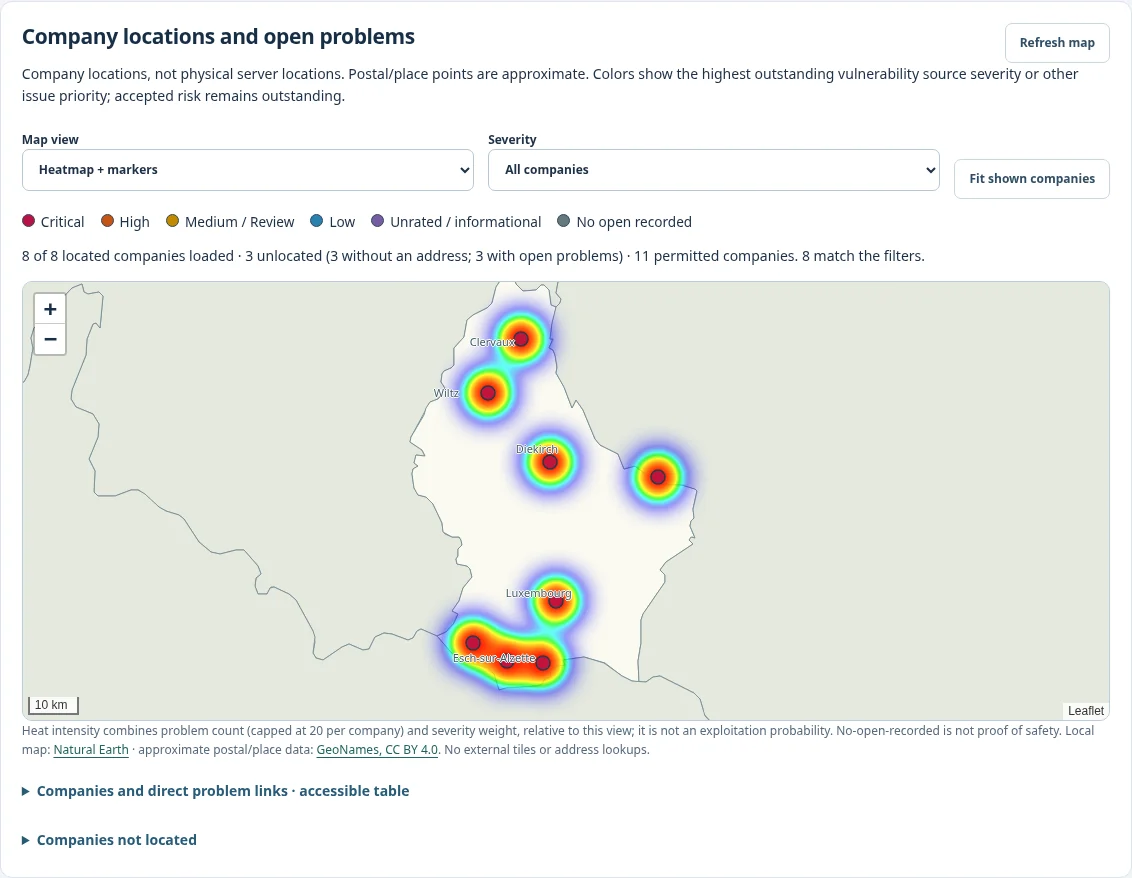
Company locations are approximate and may differ from server locations. The map describes participating inventory, not complete national coverage.
Start small. Build confidence over time.
Accept your company admin's invitation, or register a new company and confirm your email. CIRCL sharing is reviewed separately.
Start with a contact and one domain or network. Add inventory manually, review a CSV import or reuse an approved NetBox source.
Check version and coverage gaps, review vulnerability evidence and assign the next action. A match alone is not confirmed affectedness.
Confirm data periodically, review contact responsiveness and track actions. Setup saves along the way, so your team can return later.
THE OPTIONAL LINUX CLIENT
Install once on your Linux servers. The Bearings client regularly reports software versions to the CIRCL service, so updates become visible without maintaining package lists by hand.
Ubuntu, Debian and RPM package versions are collected automatically. Configured checks can also cover software installed outside the package manager.
Use a limited rollout code with your existing deployment process. Each host creates its own key and sends signed reports over HTTPS; no files need to be carried back for import.
Bearings compares supported distribution packages with vendor security rules and separates potential issues, unresolved checks and fixes already present in the installed version.
With operator-enabled managed NetBox, hosts can also register in the correct company inventory. VM tags such as LXC, Incus, Proxmox or VMware keep the deployment type visible. Existing read-only inventories remain read-only.
Get started with the free serviceReuse the ecosystem

Inventory
Approved, scoped device, VM, IP and prefix imports.

Vulnerability evidence
Public product mappings and CVE evidence for review.


Risk context
Public scenario definitions and reviewed company-specific business context.

Your MISP intelligence
Optional customer-owned keys; separate internal CIRCL research.

Monitoring configuration
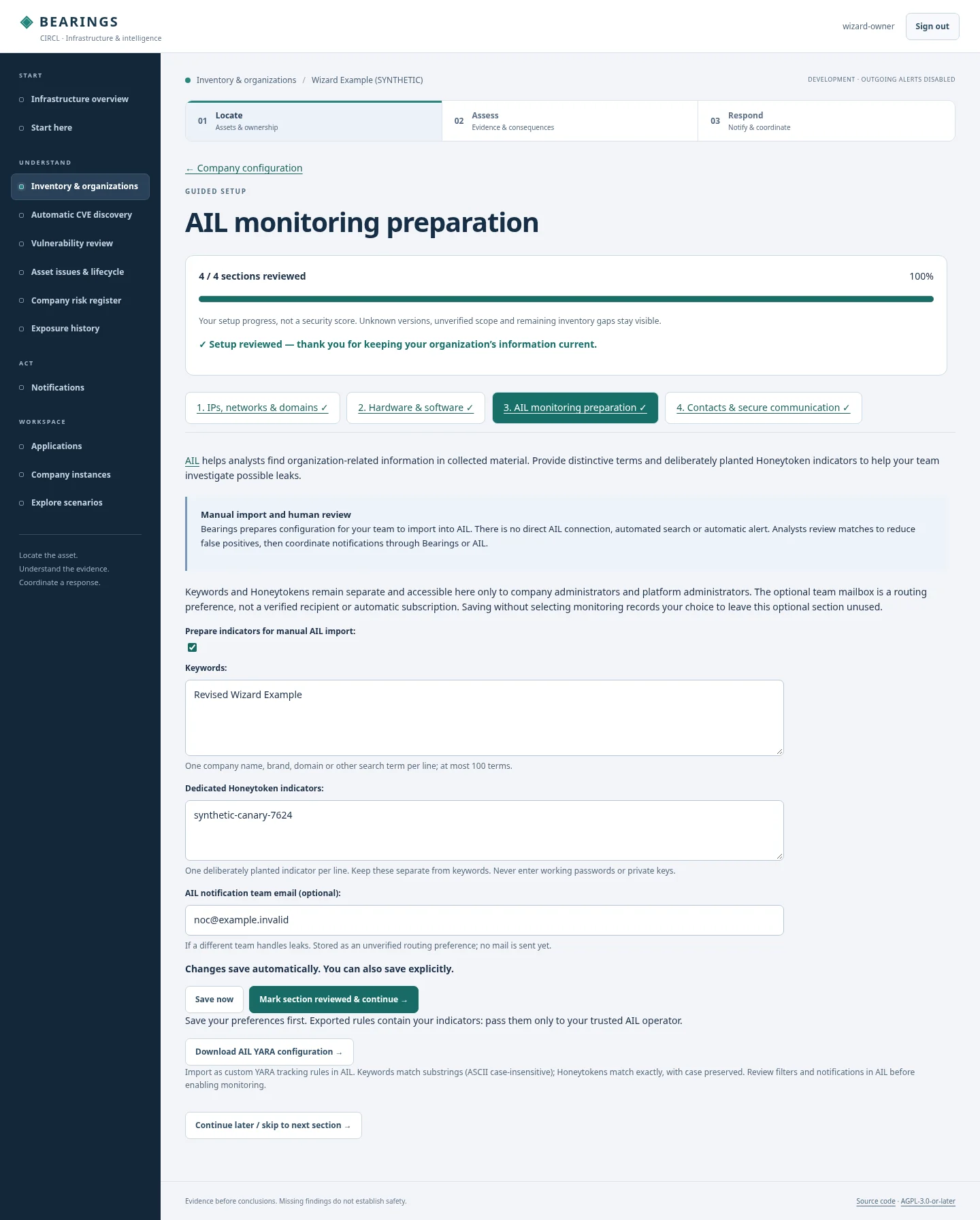
Keyword and honeytoken export for manual import and analyst review.



Coordination
Reviewed case/ticket hand-offs with independent native permissions.
Integrations have different maturity and deployment requirements. AIL is a manual export; the MISP cache is a bounded pilot. Core company workflows do not require an account in every connected tool.
Trust comes from explicit boundaries
Company roles and separate CIRCL sharing control infrastructure access. Personal MISP views use their owner's upstream permissions.
Unknown versions, stale sources and incomplete coverage do not become a green assurance badge.
Risk acceptance, recipient handling and outreach require review. Bearings does not install patches or turn every match into an incident.
This Bearings installation is operated by CIRCL. CIRCL is Luxembourg’s CERT for the private sector and municipalities. The Law of 5 May 2026 implementing NIS2 designates CIRCL as a CSIRT; Article 9 names CIRCL as the coordinator for coordinated vulnerability disclosure. We scan for vulnerabilities and support voluntary information sharing so organizations can act earlier.
Yes. The CIRCL-operated Bearings service is free and will remain free, including continued use after registration. Start with a responsible contact and one domain or network, then add details over time. Colleagues can join by invitation. Optional external tools have their own account and operating requirements.
No. Start with a responsible contact and one domain, IP address or network. Add hardware, software and versions over time. A resumable setup guide and individual editors let you continue later. Unknown or missing data remains visible as a coverage gap.
A match starts a review. A product name or a high CVSS score alone does not prove that a particular installation is affected. Review the version, exposure and evidence, assign responsibility, and record the tested action. Bearings does not install patches or infer successful remediation from an empty issue list.
Bearings is a development and pilot project with automated tests and synthetic reference deployments. Tests with 40,000 companies and 1.2 million assets passed within the documented resource and workload limits. This is not a production approval: sustained testing on the intended deployment, real-service permissions and versions, operational email delivery, monitored jobs, backup/restore, retention and native-account revocation still require validation.
BEARINGS · AGPL-3.0-OR-LATER
Register with CIRCL, confirm your email and add a responsible contact plus one domain or network. Your private company workspace opens after confirmation; sharing with CIRCL is reviewed separately.